

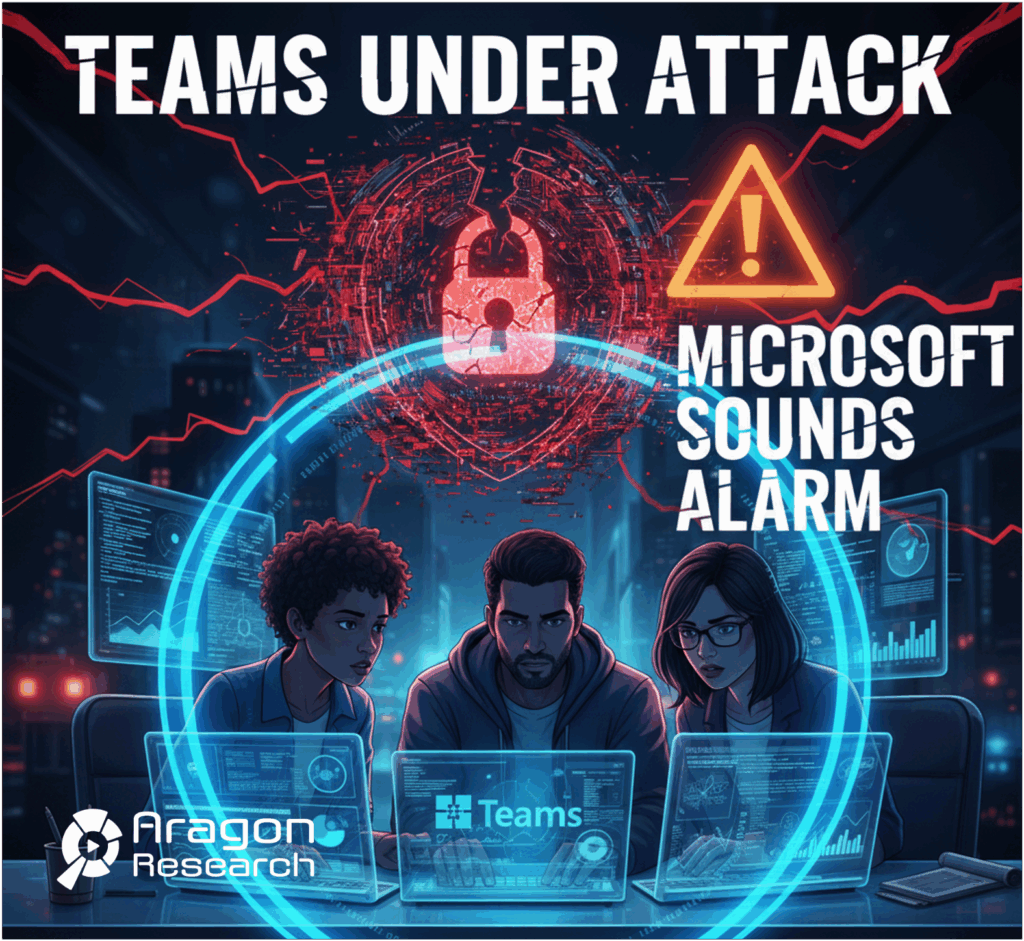
Teams Under Attack: Microsoft sounds Alarm
By Jim Lundy
Teams Under Attack: Microsoft sounds Alarm
The rise of hybrid work has transformed Microsoft Teams into an essential business hub, but this rapid adoption has created a new, high-value target for cybercriminals. What started as a simple collaboration tool is now a sophisticated vector for social engineering, malware delivery, and data theft, going far beyond typical email phishing. Microsoft’s recent warnings confirm that threat actors are now actively weaponizing Teams features, including the new layer of AI agents like Copilot, to gather intelligence and penetrate corporate networks. This blog overviews the emerging threat landscape on Microsoft Teams and offers our analysis.
Why Did Microsoft Sound the Alarm?
The core news revolves around increasingly sophisticated attacks where hackers exploit Microsoft Teams’ fundamental features—chat, external access, and file sharing—to bypass traditional security perimeter controls. Cybercriminals are now impersonating trusted entities, such as internal IT help desks or vendors, to trick employees into taking action. Attackers leverage techniques like initiating fake support calls, sending malicious links or files, and persuading users to install remote access software like Quick Assist or AnyDesk.
This approach is highly effective because users instinctively trust communications within a corporate collaboration platform, lowering their guard compared to external email. The combination of easy identity spoofing and a direct path to the user’s desktop makes Teams a powerful new staging ground for ransomware and data exfiltration, a threat now amplified by the introduction of autonomous AI.
Analysis: The Identity-Centric Impact
This escalation of Teams-based attacks signals a critical shift in the security landscape: the complete erosion of the traditional network perimeter. The news is less about a platform vulnerability and more about the weaponization of trust and identity, which now includes the non-human identities of AI agents. The core issue is the Access-Trust Gap created when new tools like Copilot and custom bots inherit the over-permissioned access of human users, making them vulnerable to exploits like prompt injection.
For the enterprise market, organizations relying on legacy network-centric security are fundamentally exposed. Teams attacks leverage an internal vector, making them significantly harder to detect and stop with firewalls or secure email gateways alone. This new threat demands a transition to security solutions that focus on validating every user, every transaction, and every access request, treating an internal Teams chat with the same scrutiny as an external email.
To specifically govern the autonomous actions of AI in this context, Aragon Research has defined the emerging market of Agentic Identity and Security Platforms (AISP). AISP provides the necessary framework to secure these non-human identities, ensuring every action taken by an AI agent is traceable, governed, and confined by adaptive, least-privilege policies. The implication is clear: security vendors must now prioritize collaboration platforms and their embedded AI agents as a primary security domain or risk becoming irrelevant.
Enterprise Action: Mandate Zero Trust for Collaboration
Enterprises should not view this news as merely a “watch” item; it requires immediate and specific action. This threat must be understood deeply and evaluated as a top-tier security risk. Specifically, enterprises must:
Reinforce MFA Resistance: Acknowledge that MFA is not an absolute defense. Focus training on MFA fatigue attacks and token theft, where attackers use social engineering within Teams to trick users into accepting fraudulent MFA prompts or sharing session tokens. Adopt passwordless authentication or hardware tokens to increase resilience against these specific bypass techniques.
Restrict External Access Defaults: Review and restrict external and guest access policies in Teams. Limit chat and meeting invites to trusted, verified domains only. By default, external communication should be disabled until a clear business need is established.
Enhance User Training: Deploy targeted security awareness training that specifically simulates and addresses Teams-based social engineering attacks, such as fake IT support requests and malicious file shares, and warns against uploading sensitive data to AI tools.
Bottom Line
The sophistication of Microsoft Teams cyber attacks proves that collaboration platforms are now critical enterprise attack vectors, successfully exploiting the trust employees place in internal communication channels, whether human or agentic. The primary defense must shift from a perimeter approach to an identity-centric Zero Trust strategy that is resilient against MFA bypass techniques and includes the new category of Agentic Identity and Security Platforms. Enterprises must immediately reinforce user identity defenses, aggressively restrict external access, and conduct hyper-specific user training.
Failure to secure the collaboration channel and its embedded AI is no longer a risk of data leakage; it is a direct invitation for large-scale ransomware and credential theft. Treat your Teams environment as the new high-value endpoint it is.

Have a Comment on this?