


Dreamforce: the launch of Role based Agents
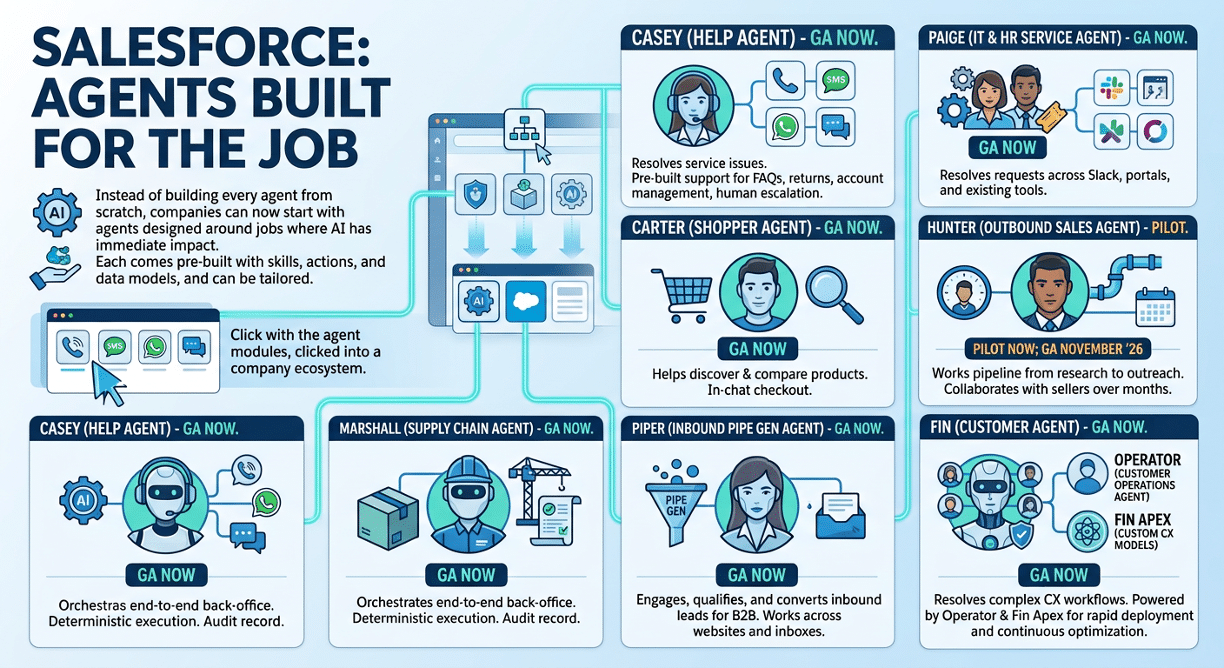
Design by Aragon, rendered by Gemini.
By Jim Lundy
Dreamforce 2026: the launch of Role based AI Agents
Artificial intelligence is rapidly transitioning from simple conversational assistance to autonomous execution. Organizations are realizing that prompt-based tools require too much human intervention to scale effectively across complex enterprise environments. Salesforce recently introduced a major platform expansion that deploys seven pre-configured digital workers to handle specific corporate roles rather than generic tasks. This blog overviews the early pre-Dreamforce Salesforce Agentforce expansion news and offers our analysis.
Why Did Salesforce Announce Agentforce Agents
Enterprise technology buyers are currently experiencing severe copilot fatigue. Early generative implementations failed to deliver measurable operational returns for many organizations. Software vendors now face intense market pressure to demonstrate direct business impact beyond basic text summarization and email drafting.
Salesforce introduced these job-ready agents to accelerate enterprise time-to-value. The platform embeds domain-specific logic directly into its infrastructure. This allows buyers to deploy digital workers without building complex custom workflows from scratch.
It positions the core platform as the definitive execution layer for corporate operations. The inclusion of a long-horizon runtime enables these agents to execute extended workflows over multi-week cycles. This addresses an urgent enterprise demand for measurable software capabilities.
Analysis
The transition from interactive software copilots to autonomous digital workers marks a structural shift in enterprise software distribution. Aragon Research observes that Salesforce is strategically attempting to reshape software monetization expectations. The market is moving away from seat-based subscription models toward outcome-driven digital work metrics.
While we can say that the names of the new Salesforce Agents may not be memorable, we do think that competitors across the enterprise landscape will be forced to quickly replicate this role-based deployment framework. Legacy software providers that rely heavily on manual human inputs will face severe margin compression. Autonomous execution is rapidly becoming the standard benchmark for enterprise applications. Providers failing to adapt will likely exit the market within the next strategic cycle.
Deploying specialized agents for functions such as supply chain tracking directly targets traditional business process outsourcing providers. It also threatens legacy service management vendors who rely on ticketing volume. Enterprise procurement teams will increasingly demand value-based pricing tied to task resolution rather than user licenses.
However, the true bottleneck for enterprise adoption remains underlying data maturity. Autonomous software execution requires high-grade real-time data integration and well-defined metadata schemas. Organizations operating with fragmented internal data architectures will struggle to delegate authority to these agents. Doing so without proper frameworks risks severe execution errors and compliance violations.
Enterprise Action Plan
Enterprise leaders should actively evaluate these offerings through targeted proof-of-concept deployments. Immediate implementation should focus on internal predictable workflows rather than external customer interactions. Deploying agents for employee password resets or initial ticket routing provides a safe testing environment to gauge operational competence.
Technology teams must conduct thorough security reviews and evaluate existing architecture readiness before enabling autonomous transactions. Organizations should map out data dependency pipelines immediately. You must determine which business units possess the data cleanliness required for operational authority.
Integrating these agents requires revising identity access controls to account for non-human identities. Your technology stack will need strict governance protocols to monitor agent activity. Ensure that you have clear rollback procedures if an autonomous worker begins executing outside of its designated parameters.
Bottom Line
Salesforce Agentforce represents a pivotal shift toward outcome-oriented enterprise automation. This announcement forces competing platform vendors to accelerate their own autonomous software strategies or face rapid irrelevance. Enterprise technology architects should evaluate these specialized agents today to understand their long-term impact on legacy systems. Deployment must remain strictly gated by modern data governance policies and clear operational guardrails.
Agentforce Roles and Functions
Here is a breakdown of the specific digital workers introduced in this release.
| Agent Name | Role | Primary Function |
| Casey | Customer Service | Processes returns, handles service tickets, and manages shipping delays. |
| Paige | HR & IT | Manages internal employee requests and portal queries via Slack. |
| Carter | Commerce | Answers product questions and supports in-chat checkout for shoppers. |
| Hunter | Outbound Sales | Pursues sales goals autonomously over days or weeks managing pipelines. |
| Marshall | Supply Chain | Keeps logistics and complex supply chain operations flowing smoothly. |
| Piper | Inbound Pipeline | Catches inbound website queries and generates qualified leads. |
| Fin | Customer Support | Handles broader technical support work alongside Casey. |
Related Blogs:
BoxWorks 2025: AI Agents and the Enterprise Content Challenge
Microsoft and Nvidia partner to save Windows
Dropbox Navigates the Content Intelligence Race
Important Research related to this Blog:
Also – Check out all our Podcasts HERE
Have a Comment on this?