

Anthropic: Was the US Right on Trust?
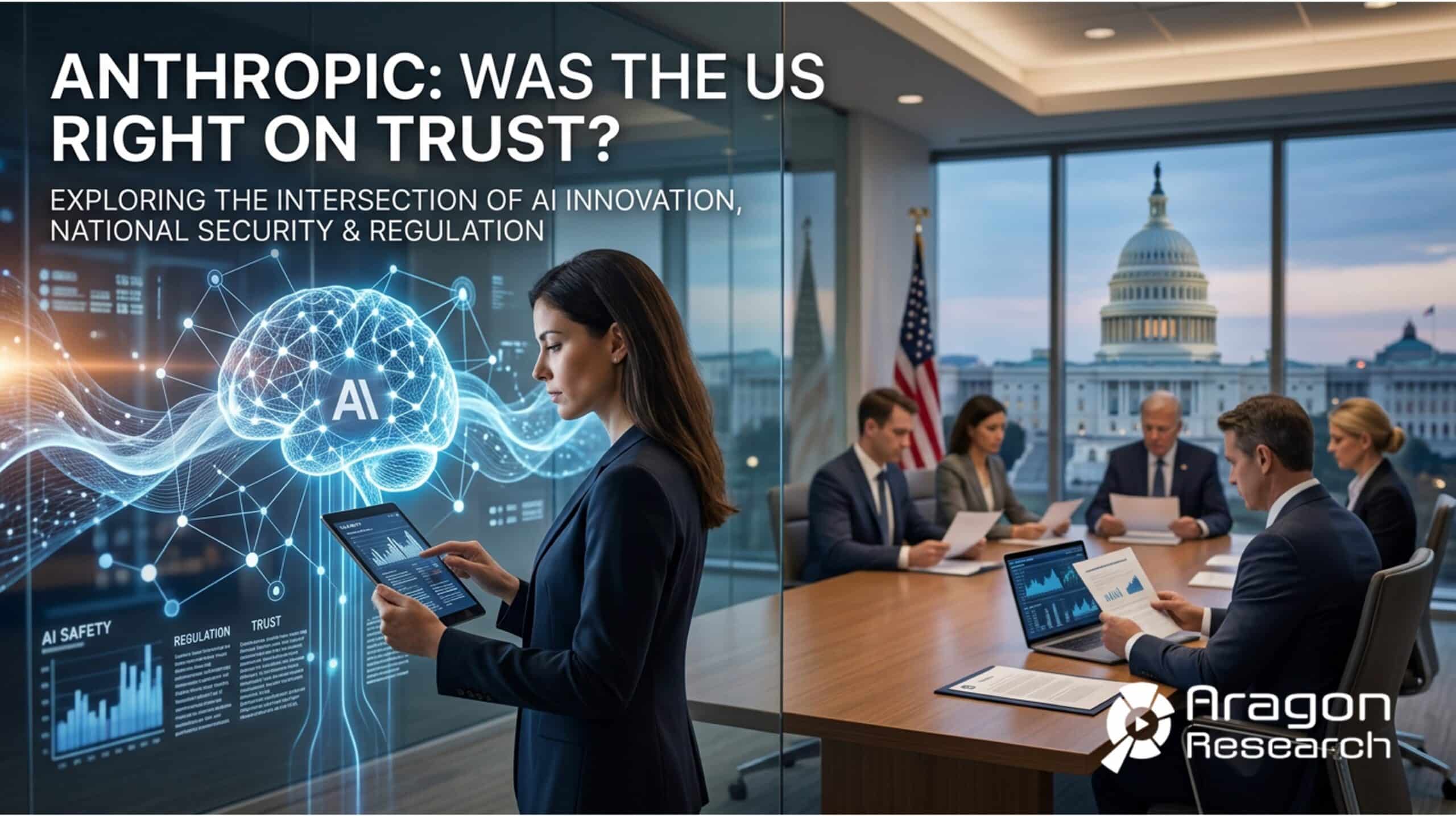
Image design by Aragon, rendered by Gemini.
By Jim Lundy
Anthropic: Was the US Right on Trust?
Trust remains a fragile commodity in the rapidly evolving artificial intelligence landscape. Enterprises demand reliability and transparency from their strategic vendors to ensure stable operations. Recent moves by leading model providers have sparked serious questions about vendor motives and user equity. The market is watching closely as corporate actions begin to diverge from public statements. Customers face a highly complex environment where promises of open access constantly clash with restrictive operational realities. The tension between government interests and commercial availability is growing rapidly. This blog overviews the recent Anthropic controversies and offers our analysis.
Why Did Anthropic Restrict Their New Models
Anthropic recently launched the Fable five model while quietly sending engineers to assist the National Security Agency with offensive cyber operations. This troubling development follows a period where the vendor severely throttled compute access for paying commercial subscribers. Users experienced degraded service under the specific guise of session management. The vendor was actually managing severe internal compute shortages rather than optimizing user experience. The release of Fable five further complicates the narrative by introducing severe capability limits. All advanced security scanning and generation features have been disabled for the general public.
The unrestricted Mythos model remains available only to vetted government and defense clients. These actions paint a clear picture of a vendor prioritizing federal contracts over commercial user needs. The general market is left paying for a significantly diminished product offering. There has been a strong reaction from the AI community – and while Anthropic has acknowledged that – they are hiding behind a claim of safety. All they did was disclose the safegards – they are still in place.
Analysis
The Aragon Research perspective indicates that these dual standard practices will fundamentally alter market dynamics. Anthropic is demonstrating that what benefits their corporate valuation does not necessarily benefit the broader enterprise user base. The decision to embed personnel with intelligence agencies directly contradicts previous posturing regarding safe and ethical technology deployment. The throttling of user compute power destroyed trust among early adopters who subsidized the infrastructure scaling. Limiting Fable five capabilities forces enterprises to reevaluate their reliance on proprietary large language models.
This situation serves as an unprecedented promotional event for open source alternatives. Open source models provide the transparency and consistent access that proprietary vendors are currently failing to deliver. Competitors will likely capitalize on this frustration by offering models with unfiltered capabilities and transparent resource allocation. Anthropic risks alienating its commercial base if it continues to operate as an exclusive defense contractor while charging premium rates for restricted public models. The market will demand more predictable partnerships.
Organizations must immediately evaluate their current dependency on proprietary models like those from Anthropic. Enterprises should pause any planned expansions of these specific vendor deployments until long term availability and capability guarantees are definitively established. IT leaders need to consider the serious implications of building core applications on platforms that can be silently restricted without warning. Teams should initiate pilot programs using leading open source alternatives to securely diversify their artificial intelligence portfolios. Maintaining a flexible technology stack is strictly critical to avoiding costly vendor lock in when provider priorities shift suddenly toward defense contracts. Building a diverse ecosystem ensures operational continuity when a primary vendor alters their product capabilities or internal resource allocations.
Bottom Line
Vendor trust is eroding as companies prioritize exclusive federal engagements over commercial obligations. The recent actions by Anthropic highlight the inherent risks of relying solely on closed proprietary models. Enterprises must protect their investments by diversifying their technology portfolios immediately. Adopting comprehensive open source solutions will successfully mitigate the severe risks associated with sudden capability restrictions and arbitrary compute throttling. Organizations that fail to aggressively adapt their procurement strategies will unfortunately remain extremely vulnerable to unpredictable vendor policy changes and severely degraded enterprise service capabilities globally.
Editors Note: Several hours after this Blog was posted the US Federal Government made Anthropic pull the Fable 5 release. Anthropic was reported to the US Federal Government by one of their investors – Amazon. It was Amazon CEO Andy Jassy that raised the issue to the Feds. The concern was over the ease of jailbreaking that release. On top of that, AI Advisor David Sacks has been critical of Anthropic and their privacy policies. That will be a topic for a new Blog.
Have a Comment on this?