

Nvidia Disrupts With 3 Open Nemotron Models
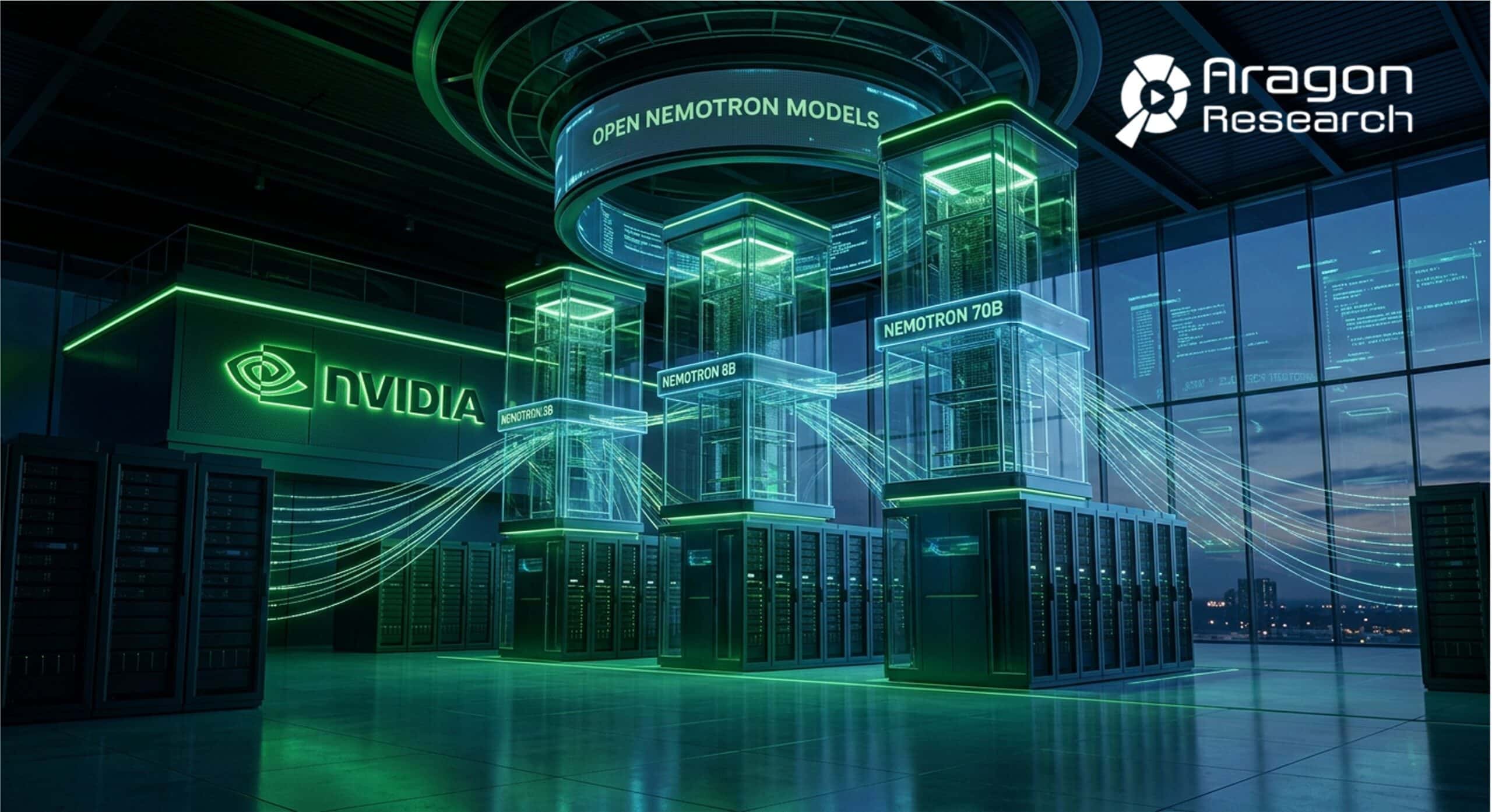
Image design by Aragon, rendered by Gemini.
By Jim Lundy
Nvidia Disrupts With 3 Open Nemotron Models
Hardware dominance alone no longer guarantees long-term control of the enterprise computing stack. As enterprises balk at the recurring costs of proprietary frontier models, the battleground has shifted toward downloadable software that companies can own and modify. Nvidia has expanded its software portfolio by releasing three new open-weight Nemotron models designed specifically for autonomous workflows. This blog overviews the Nvidia Nemotron 3.5 announcement and offers our analysis.
Why Did Nvidia Announce the New Nemotron Open Models?
Nvidia debuted three additions to its open-weight family: Nemotron 3.5 Super VL, Nemotron 3.5 Bolt 74B-A9B 24GB, and Nemotron Bolt E4B 4GB. Open-weight models allow organizations to download, inspect, and post-train the software on proprietary corporate data without paying ongoing token fees to cloud providers. This release targets agentic workflows across a wide hardware spectrum, ranging from heavy data center clusters down to local desktop computers.
Each model addresses a distinct operational tier. Nemotron 3.5 Super VL is engineered to manage complex, multi-week agentic tasks and supports deep customization with internal enterprise data. The mid-tier Bolt 74B model executes general agent tasks such as navigating web browsers and operating software applications. At the edge, the compact Bolt E4B model requires just four gigabytes of memory to power physical robotics and conversational agents. By releasing these models, Nvidia provides domestic alternatives to popular Chinese open-weight ecosystems like Alibaba Qwen and Moonshot Kimi K3.
Analysis
At Aragon Research, we view this release as a calculated move to prevent enterprise cloud lock-in and protect hardware margins. Closed-model providers want enterprises to rent intelligence through costly application programming interfaces. If a handful of closed-model vendors consolidate the market, they gain the pricing leverage to dictate hardware purchasing or migrate workloads onto their own custom silicon. By giving away capable open-weight models, Nvidia commoditizes the software layer to ensure enterprises continue buying its chips for on-premises servers and local workstations.
The specific focus on memory footprint and multi-week agent execution signals a major market shift. Most enterprise workflows do not require the massive reasoning capacity of frontier models. They require small, predictable agents that can navigate a browser or run on a four-gigabyte local device without sending sensitive corporate data to a third-party server.
This announcement means pure-play model providers can no longer charge a premium for basic agentic execution. Competing silicon vendors will now need to replicate this full-stack approach by releasing their own pre-trained, size-optimized open models, or risk losing the developer ecosystem entirely to Nvidia. Furthermore, by aggressively countering Chinese open-weight dominance, Nvidia positions its software stack as the default standard for western enterprises that face strict regulatory and data sovereignty mandates.
What Should Enterprises Do About This News?
Technology leaders should immediately evaluate the Nemotron 3.5 family and consider its implications on their existing artificial intelligence stack. Organizations currently paying high monthly fees to closed-model providers for routine browser automation or conversational bots should test Bolt 74B and Bolt E4B as lower-cost replacements. Enterprise architects must audit their upcoming workflows to separate tasks that genuinely need frontier cloud reasoning from those that can run privately on local hardware. Security and compliance teams should also examine Nemotron 3.5 Super VL for multi-day internal processes where proprietary data cannot leave corporate firewalls.
Bottom Line
Nvidia is leveraging free, open-weight software to drive universal demand for its hardware across data centers and edge devices. By tailoring the new Nemotron models for specific memory footprints and long-running agentic tasks, the company removes both the cost and privacy barriers of artificial intelligence adoption. Enterprises should download and benchmark these models against their current cloud services to reduce operational spending and retain full ownership of their corporate data.
Related Blogs:
Gemini 4 Smashes AI Agent Limits for Argon
Google Teases Gemini 4 after Record Q2
Gemini 3.8 Sets a New Bar for Agentic AI
How Anthropic won the PR Narrative but Google kept the Volume
Google Nano Banana: Free AI Image Tools for All
Important Research related to this Blog:
Also – Check out all our Podcasts HERE
Have a Comment on this?