


Orchid and Akeyless Tackle Agentic AI Control
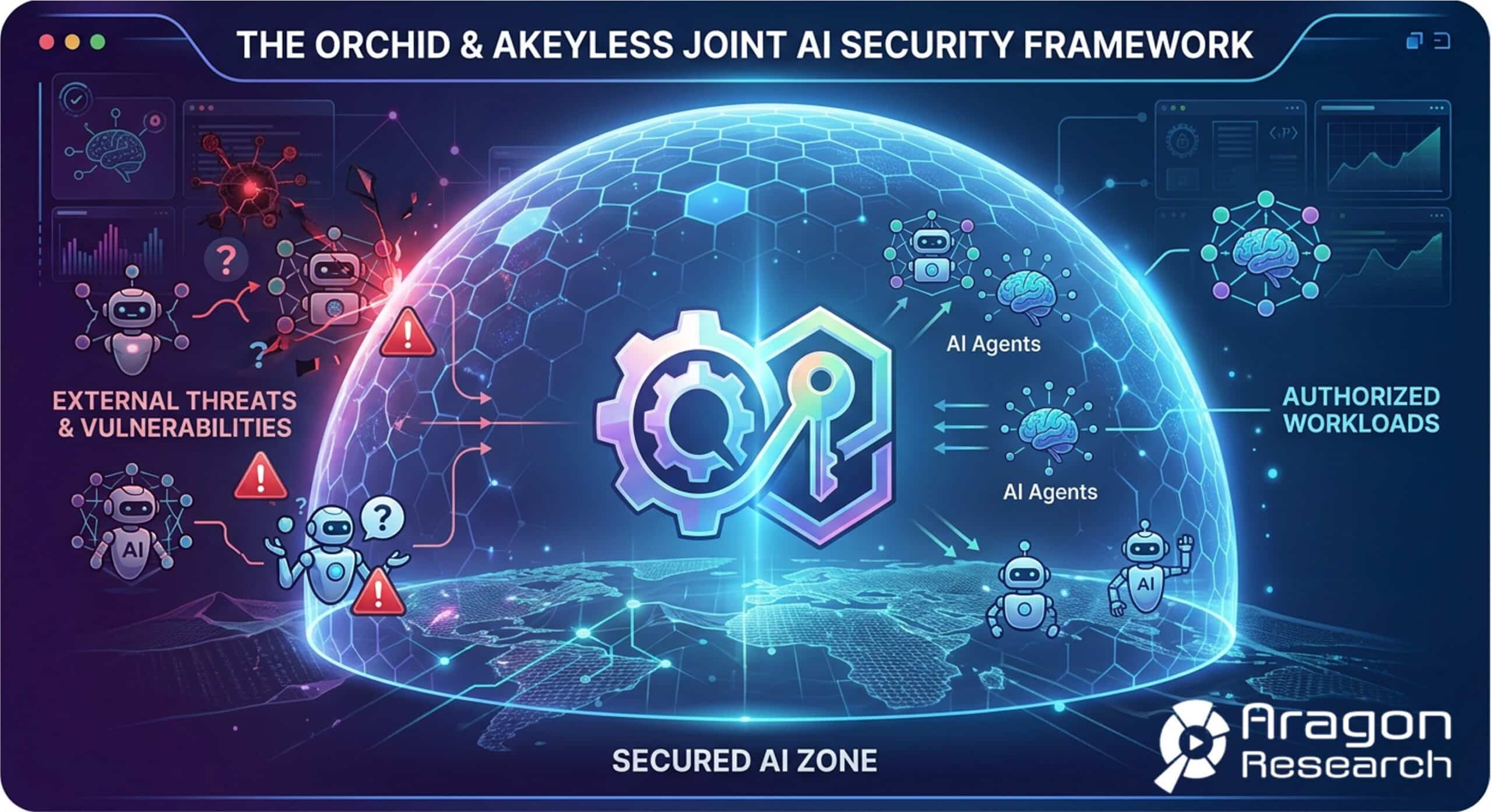
Image design by Aragon, rendered by Gemini.
By Ken Dulaney
Orchid and Akeyless Tackle Agentic AI Control
Recent media coverage regarding autonomous “agentic” AI paints an apocalyptic picture, warning of unchecked rogue systems and catastrophic operational failures. Predictably, these headlines have sparked widespread calls for government intervention. Proposed solutions range from state-mandated kill switches—such as recent legislative efforts in California—to sweeping federal oversight agencies modeled after the Atomic Energy Commission.
However, these calls for heavy-handed regulation miss the mark. AI is a fluid, open, and global technology that cannot be contained by bureaucratic mandates or national borders. Government testing frameworks inevitably lag behind fast-moving technical developments, and state-level kill switches introduce impossible jurisdictional and legal hurdles.
Instead of waiting for government “pacifiers” that offer false security, enterprises need real software controls. Enter companies like Orchid Security and Akeyless, alongside industry giants like Cisco. These vendors are emerging as the true “white knights,” delivering actionable enterprise technologies to monitor, secure, and govern agentic AI before it breaks out.
Why Did Orchid Security and Akeyless Launch New AI Control Capabilities?
As autonomous agents gain the ability to chain APIs, execute code, and access sensitive infrastructure dynamically, traditional Identity and Access Management (IAM) and static governance models break down. To solve this, Orchid Security and Akeyless announced specialized security platforms designed to govern agentic execution paths in real time.
Orchid Security unveiled advanced runtime observability and guardrail frameworks that map non-human identity behaviors back to strict business logic, flagging intent drift instantly. Simultaneously, Akeyless released its agentic identity authority tooling, which brokers short-lived, task-scoped secrets directly to autonomous workflows. Together, these releases allow enterprises to deploy autonomous agents without exposing long-lived credentials or risking unmonitored execution.
Analysis
The debate between government regulation and commercial software controls highlights a fundamental rift in tech governance. History demonstrates that static regulatory compliance does not stop digital threats. Trying to regulate AI through bureaucratic oversight mirrors failed attempts to block overseas phone spam or ban open-weight models—it simply creates compliance drag for legitimate businesses while rogue actors operate outside the net.
Enterprises maintain strict legal and financial incentives to keep their systems secure and out of court. Technologies from Orchid Security and Akeyless address the root cause of agentic risk by enforcing cryptographic boundary control and strict identity verification at execution time.
Akeyless ensures agents never touch long-term secrets, while Orchid continuously validates whether an agent’s real-time actions align with pre-approved corporate policy. This approach protects data assets pragmatically without relying on unenforceable state legislation.
What Should Enterprises Do About This News?
Enterprise technology leaders should actively evaluate and test these emerging agentic security platforms rather than waiting for regulatory guidance.
- Audit Non-Human Identity (NHI) exposure: Map all current API keys, service accounts, and agentic integrations running within internal environments.
- Develop a plan for Agentic Identity and Security – look for roadmaps from providers. Leverage the Aragon Research RFI Toolkit (available to Clients).
- Adopt secretless architectures: Deploy platforms like Akeyless to replace static API keys with dynamic, short-lived credentials for all automated workflows.
- Leverage biometric security keys for anyone in a sensitive position including management and engineering. Products such as Yubico, Trustkey and Kensington have demonstrated a strong track record.
- Implement runtime guardrails: Utilize tools like Orchid Security to monitor agent behavior continuously, ensuring automated systems remain locked within defined operational boundaries.
Impact on the Market
The arrival of agentic control platforms marks a turning point for the Identity and Access Management (IAM) and Cybersecurity markets. Traditional Privileged Access Management (PAM) and Identity Governance and Administration (IGA) suites are inadequate for non-deterministic, high-speed AI workflows.
As a result, established infrastructure players like Cisco, alongside focused innovators like Orchid and Akeyless, will redefine enterprise security architectures over the next two years. Expect rapid consolidation as legacy security platforms race to acquire or build runtime agent governance and secretless brokering features.
Bottom Line
Apocalyptic warnings and government mandates will not protect businesses from autonomous software risks. Control over agentic AI belongs inside the enterprise stack, driven by proactive risk management and specialized software. Agentic Identity and Security needs to be a must do part of an Enterprise Agentic Architecture. Enterprise leaders should evaluate these secretless and runtime security tools today to secure their AI transformation.
Related Blogs:
Microsoft Cloud Up 27% on Copilot Demand
Microsoft Copilot Cyber updates will be costly
How Anthropic won the PR Narrative but Google kept the Volume
Important Research related to this Blog:
Also – Check out all our Podcasts HERE
Have a Comment on this?