Frequently Asked Questions on Agentic Identity and Security
Q: What is an Agentic Identity and Security Platform (AISP)?
A: Agentic Identity and Security Platforms (AISP) is an emerging cybersecurity category vital for safeguarding enterprises utilizing digital labor. AISP provides a specialized, run-time policy enforcement framework that identifies, secures, and governs AI agents and agentic systems.
Q: What is the "Access-Trust Gap" in AI security?
A: The Access-Trust Gap refers to the security risks posed by unknown or untrusted identities, unknown applications, unmanaged devices, and AI apps accessing company data without proper authorization. It is primarily caused by using traditional security frameworks that are ill-equipped to manage the unpredictable behaviors of AI agents.
Q: Why can't we use traditional Identity and Access Management (IAM) for AI agents?
A: Traditional IAM frameworks, like OAuth and SAML, are designed for static permissions and human users. AI agents require granular and adaptive access control that can change dynamically based on real-time context, assessed risk levels, or evolving mission objectives. Treating an AI agent as an extension of a human user can lead to dangerous over-permissioning.
Q: What are the primary security threats to AI agents?
A: AI agents face unique vulnerabilities, including prompt injection, where attackers manipulate an agent's behavior via malicious inputs. Other severe threats include unexpected Remote Code Execution (RCE), agent communication poisoning, and the unmanaged sprawl of "Shadow AI agents" deployed without IT oversight.
Q: What is agentic identity?
Agentic identity refers to the unique, verifiable identity assigned to an AI agent, similar to how a human user is identified on a network. It involves using credentials and identity attributes to verify an agent, which then allows it to be granted access to data, applications, and other resources within an enterprise. According to the report, a leading Agentic Identity and Security Platform (AISP) will not only verify these identities but also ensure access is granted dynamically with permissions scoped precisely to the immediate task.
Q: What is agentic security?
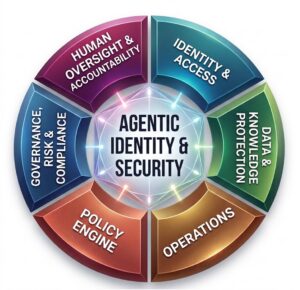
A: Agentic security is the practice of securing AI agents and agentic systems. It is a specialized security approach that goes beyond traditional frameworks designed for humans. It addresses the unique risks posed by autonomous AI agents, such as their dynamic and unpredictable behaviors. The core of agentic security, as outlined in the document, involves a platform (AISP) that provides robust identity and access management, data protection, governance, risk and compliance (GRC), a policy engine for runtime enforcement, and mechanisms for human oversight and accountability.
Q: Who came up with the Agentic Identity and Security concept?
A: Aragon Research introduced the concept of Agentic Identity and Security Platforms (AISP) in their research note dated June 4, 2025.
Q: What is an Agentic Identity and Security Platform (AISP)?
A: An Agentic Identity and Security Platform (AISP) is an essential, emerging category of technology designed to safeguard the modern enterprise. It provides a specialized, run-time policy enforcement framework that identifies, secures, and governs AI agents and the systems they operate in. Its key elements include agent identity management, data protection, operational integrity, and comprehensive governance, risk, and compliance (GRC) capabilities.
Q: Why are traditional security methods not enough for AI agents?
A: Traditional security frameworks, designed for human users, are ill-equipped to manage the dynamic, unpredictable behaviors, and unique vulnerabilities of AI agents. AI agents necessitate granular and adaptive access control that can change based on real-time context, which is a feature traditional static permission systems often lack. This disparity creates a significant "Access-Trust Gap."
Q: What specific security risks do AI agents introduce?
A: AI agents introduce several new security risks, including:
- Prompt Injection: Malicious inputs that manipulate an agent’s behavior.
- Tool Misuse & RCE: Exploiting agents to abuse integrated tools or execute malicious code.
- Agent Communication Poisoning: Injecting false information into inter-agent communication channels.
- Shadow AI & Unmanaged Sprawl: Unauthorized deployment of agents by employees, creating visibility gaps.
- Over-Permissioning: Granting agents excessive privileges, which expands the attack surface.
Q: How does an AISP help mitigate the risk of "Shadow AI"?
A: "Shadow AI" refers to AI tools or agents deployed by employees without proper IT and security oversight. An AISP mitigates this risk by providing a centralized framework for managing the lifecycle of all agents, from creation to decommissioning. It ensures that every agent has a verifiable identity and operates under established security policies, providing full visibility and control and eliminating the compliance and security gaps created by unmanaged agents.
Q: What are the key components of an Agentic Identity and Security Platform?
A: The six key elements of an AISP are:
- Agent Identity and Access Management
- Data and Knowledge Protection
- Agent Operational Integrity and Resilience
- Agentic Governance, Risk and Compliance
- Policy Engine with Runtime Enforcement
- Human Oversight, Accountability, and Attribution
Q: Which industries benefit most from Agentic Identity and Security?
A: Industries that handle sensitive data and are rapidly adopting AI will benefit the most. The report specifically highlights Financial Services, Banking, Fintech, Life Sciences, Pharma, Healthcare, Government, Insurance, Retail, eCommerce, Transportation, Logistics, and Technology/High-Tech as primary beneficiaries.
Q: What is the "Access-Trust Gap" in the context of AI security?
A: The "Access-Trust Gap" refers to the security risks and vulnerabilities that arise from unknown or untrusted AI agents accessing company data without proper authorization or governance. This gap is created because traditional security models are not designed to handle the autonomous and dynamic nature of AI agents.
Q: How does an AISP relate to a Zero Trust security model?
A: Implementing a full Zero Trust architecture can be a complex, multi-year overhaul. An AISP allows organizations to apply Zero Trust principles specifically to their AI agents immediately. It offers a specialized, run-time policy framework that ensures agents operate within defined guardrails with least-privilege access, accelerating secure AI adoption without waiting for a complete enterprise-wide Zero Trust transformation.
Q: What is the projected market growth for Agentic Identity and Security?
A: According to the Aragon Research forecast, the market for Agentic Identity and Security Platforms is expected to experience robust growth, increasing from $3.2 billion in 2025 to $32.9 billion by 2031, which represents a Cumulative Average Growth Rate (CAGR) of 48.8%.
Q: How should an organization get started with implementing agentic security?
A: Organizations should begin with the following steps:
-
- Assess Your Agentic Security Needs: Identify the types of AI agents you will deploy, the sensitive systems they will access, and the specific threats you face.
- Evaluate AISP Solutions: Research available platforms and select one that best fits your needs regarding features, integration capabilities, and cost.
- Test Options: Run security risk scenarios (e.g., agent spoofing, prompt injection) to validate that the chosen AISP can effectively detect, alert, or remediate threats.
Learn More