

Google’s Gemini Agent as your new Coworker
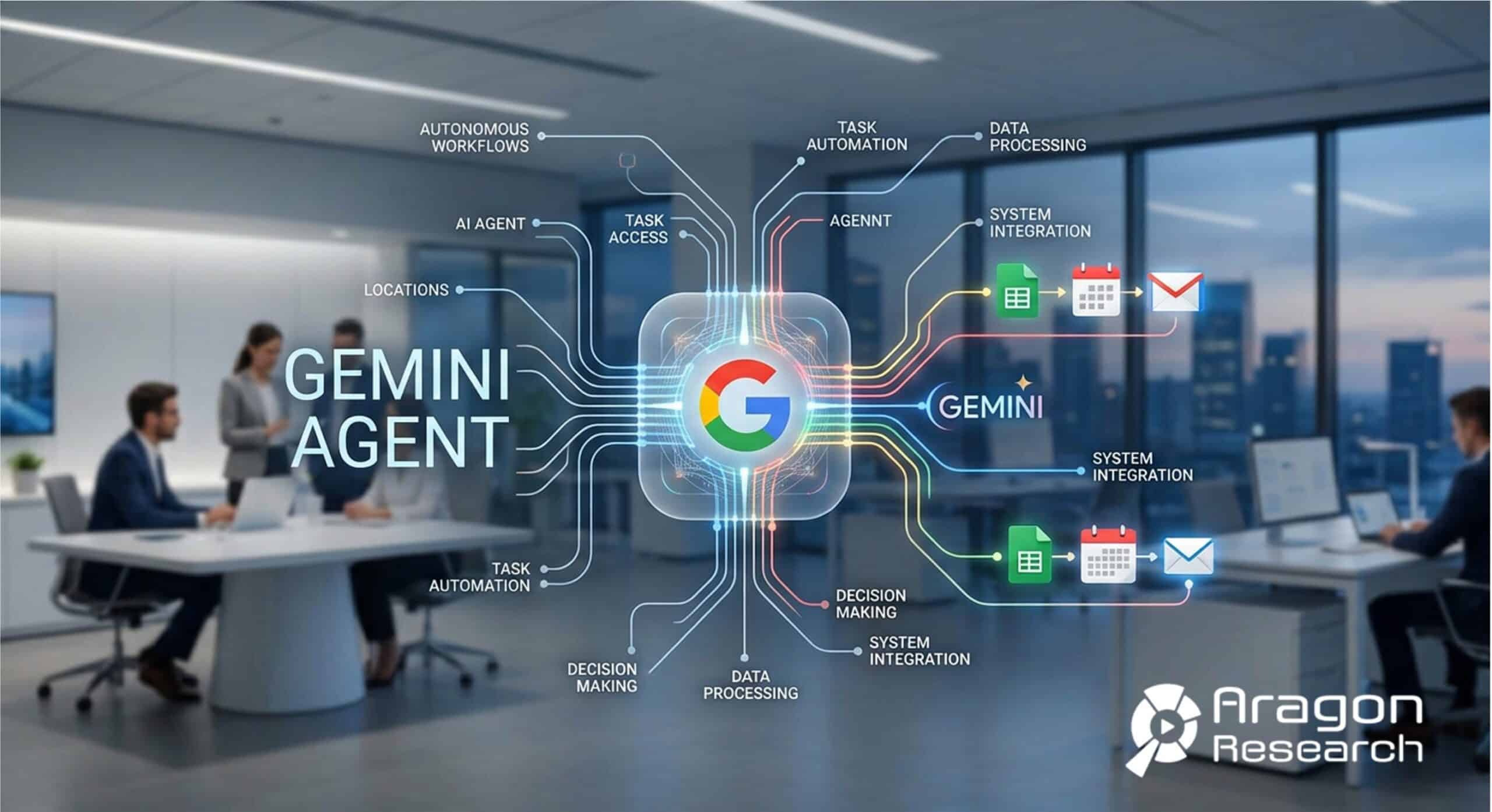
Image design by Aragon, rendered by Gemini.
By Jim Lundy
Google’s Gemini Agent as your new Coworker
The enterprise technology landscape is rapidly shifting from fragmented generative tools to cohesive digital workers. Organizations are moving beyond simple prompt generation toward autonomous systems that execute complex tasks across multiple platforms. Productivity software has historically required constant human intervention to bridge data silos and complete administrative processes.
Google Cloud recently hosted its Gemini at Work event to address this evolving demand with a centralized orchestration approach. This blog overviews the Gemini Agent announcement and offers our analysis.
Why Did Google Announce Gemini Agent
Google announced this unified offering at the new Hanger at Moffett Field in Mountain View CA.The apparent Google strategy is to address the market exhaustion associated with isolated chatbots and fragmented artificial intelligence products. The new release, which Google said should come in Q4, transitions enterprise work from manual prompting to outcome-based delegation.
The platform provides a single digital worker that runs continuously in the cloud. It operates across applications like Google Workspace, Microsoft 365, Salesforce, and Slack. It handles chat, autonomous tasks, and code execution while maintaining a persistent memory record across all systemic interactions. Interestingly, model choices include Gemini and Anthropic Claude.
Google also integrated strict enterprise governance mechanisms directly into the architecture. The platform utilizes cryptographic identities for sub-agents and introduces hard monetary spend caps to prevent runaway computational costs.
Table of Key New Gemini Features
| Feature Category | Capability Description |
| Core Architecture | Unified agent running continuously across web, desktop, mobile, and command line interfaces. |
| SaaS Integration | Native functional hooks into Google Workspace, Microsoft 365, Slack, Salesforce, and ServiceNow. |
| Open Orchestration | Decoupled model selection supporting Gemini, Anthropic Claude, and open-weight models. |
| Enterprise Governance | Cryptographic agent identities, strict role-based access control, and immutable audit trails. |
| Cost Controls | Smart routing to efficient models and project-level monetary spend caps configured by administrators. |
| Zero Data Lock-In | Borderless queries across AWS S3, Azure Data Lake, and SAP without requiring data migration. |
Analysis
The decoupling of the agent architecture from the underlying foundational model is the most consequential aspect of this release. Google is actively shifting the competitive battleground from raw model performance to enterprise workflow orchestration. In other words, Gemini Agent is Google’s new AI Assistant Coworker.
By allowing organizations to route tasks dynamically between Google models and various open-weight alternatives, Google is commoditizing the model layer. This strategy effectively positions the Google control plane as the primary operating system for enterprise productivity.
This maneuver forces competing cloud providers to rapidly replicate this multi-model agent governance or risk losing infrastructure control. Software vendors relying solely on proprietary model lock-in will need to exit that strategy and rebuild their architectures immediately.
Enterprise Action
Information technology and business leaders must evaluate this new orchestration offering immediately. The introduction of department-level spend caps and automated model routing addresses the primary barriers that have previously stalled scaled corporate adoption.
Organizations should carefully examine how a persistent digital worker alters their current technology stack and data integration strategies. The ability to query databases and customer relationship platforms without data migration creates new operational efficiencies that demand architectural review.
Start by mapping out high-volume operational processes that can transition from manual human oversight to delegated digital execution. Pilot these workflows in secure sandboxes to measure concrete operational returns before broad deployment.
Bottom Line
The transition from isolated generative utilities to systemic digital agents is officially underway and reshaping market expectations. Google has positioned its ecosystem to serve as the definitive orchestration layer for complex enterprise workloads and autonomous task management.
Enterprises must prepare their internal governance frameworks now to support these persistent digital workers. Establishing clear data perimeters, identity access controls, and strict financial thresholds today will ensure a secure deployment. Proactive planning is required to maximize returns as these autonomous capabilities become widely integrated across the market.
Related Blogs:
Gemini 4 Smashes AI Agent Limits for Argon
Google Teases Gemini 4 after Record Q2
Gemini 3.8 Sets a New Bar for Agentic AI
How Anthropic won the PR Narrative but Google kept the Volume
Google Nano Banana: Free AI Image Tools for All
Important Research related to this Blog:
Also – Check out all our Podcasts HERE
Have a Comment on this?