


Mitel WX Drives the Frontline ICX Shift
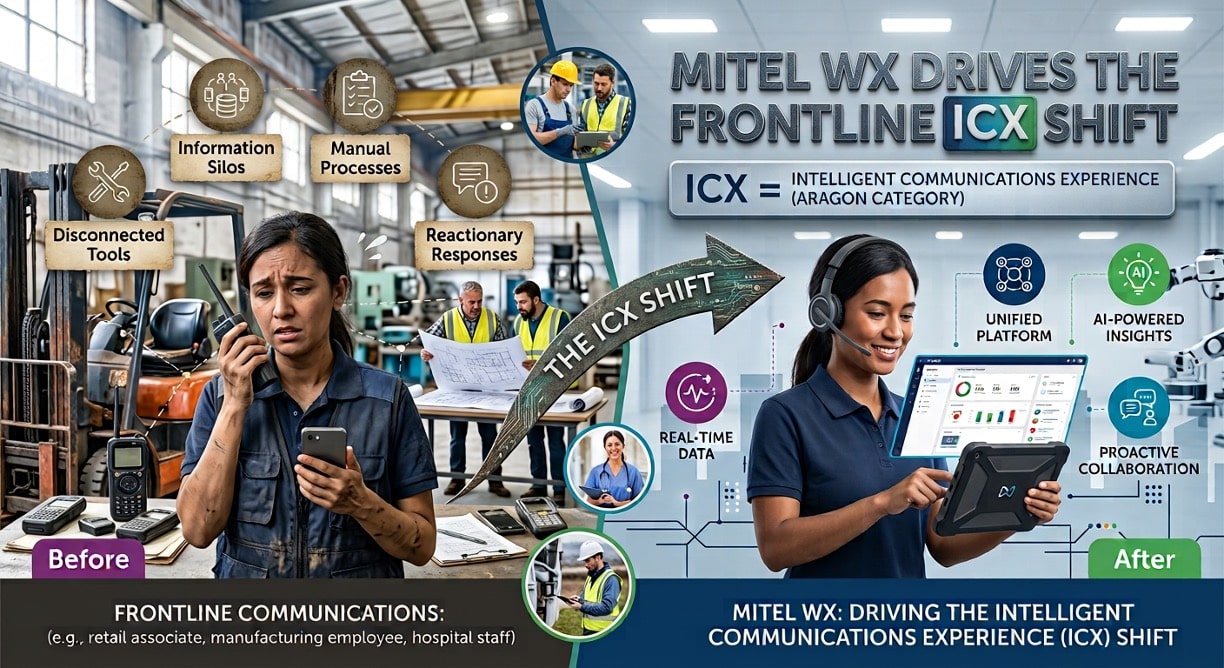
Image design by Aragon, rendered by Gemini.
By Jim Lundy
Mitel WX Drives the Frontline ICX Shift
Enterprise software designs have long favored office workers while leaving field and operational staff behind. When eighty percent of the global workforce operates without a desk, forcing employees to navigate desktop interfaces creates operational bottlenecks and security exposures. Today, enterprises are demanding integrated architectures that bring voice, messaging, and customer engagement directly to mobile and vertical-specific endpoints.
This convergence represents the rise of the Intelligent Communications Experience, or ICX, where artificial intelligence, customer experience, and unified communications collide. Mitel is addressing this market evolution by introducing a single framework tailored for both deskbound and deskless personnel. This blog overviews the Mitel WX announcement and offers our analysis.
Why did Mitel announce Mitel WX
Mitel unveiled Mitel Workforce Experience, known as Mitel WX, to resolve tool fragmentation across modern enterprises. Research indicates that fifty-seven percent of workers lose productive hours switching between an average of seven disconnected applications. Furthermore, seventy percent of frontline employees feel pressured to improvise when corporate systems fail, making them twice as likely to adopt unapproved consumer tools that introduce compliance hazards.
Mitel WX is a core communications application framework built from the ground up on an integrated hybrid platform. Rather than extending a knowledge worker tool to the field, Mitel WX delivers a role-aware, widget-based interface that adapts to each job profile across phones, tablets, and desktops. A nurse, retail associate, or contact center agent maintains a single identity across devices while accessing office productivity suites alongside specialized applications like electronic health records and clinical alerting.
Because seventy-nine percent of workers default to voice during urgent situations, Mitel WX prioritizes immediate voice connectivity without forcing users to switch applications. Through Mitel Workflow Studio, the platform embeds practical artificial intelligence to automate repetitive steps, route calls, translate text, and support hands-free voice or gesture controls. Organizations can deploy Mitel WX across private cloud, hybrid, on-premises, or edge environments via the Mitel Central portal, with initial availability starting in the fourth quarter of 2026 and full platform rollout in 2027.
Analysis
While many software vendors focus on autonomous agents designed to replace human labor, Mitel is positioning artificial intelligence to augment workers during critical operational moments. In sectors like healthcare, manufacturing, hospitality, and emergency services, software bots cannot substitute for human judgment on a hospital floor or factory line. By embedding voice control and workflow automation into mobile interfaces, Mitel shortens the path from intent to action for deskless staff.
From an Aragon Research perspective, Mitel WX is a prime example of the new ICX category in action. For decades, enterprise technology leaders purchased unified communications and contact center systems as separate silos. Mitel WX collapses that barrier by uniting internal collaboration, external customer engagement, and artificial intelligence on a shared architecture with unified context.
For Mitel, this release fortifies its enterprise installed base by providing a low-friction upgrade path through Mitel Central and Mitel Edge. Rather than competing with public cloud providers for generic office seats, Mitel is locking down regulated verticals where data sovereignty, CapEx flexibility, and power-outage resilience dictate buying decisions. Competing collaboration vendors that rely on rigid public cloud models and desktop-centric designs will need to replicate this role-based ICX framework or risk losing enterprise accounts in regulated industries.
What Enterprises Should Do
Enterprise technology leaders should evaluate Mitel WX and consider its implications on their existing communications and customer experience stack. Chief Information Officers should begin by auditing frontline workflows to identify where deskless staff rely on unauthorized applications to bypass fragmented corporate tools. Consolidating seven disconnected applications into a single ICX workspace can lower licensing costs and eliminate shadow IT vulnerabilities.
Organizations running existing Mitel voice platforms should plan pilot deployments of Mitel WX in late 2026 to test its cross-device continuity and vertical integrations. In addition, enterprises operating under strict European or North American data sovereignty mandates should assess how Mitel Edge and hybrid deployment options support their long-term compliance and business continuity architectures.
Bottom Line
Mitel WX shifts the enterprise communications focus from deskbound office staff to the frontline majority while validating the shift toward Intelligent Communications Experience. By uniting voice, messaging, contact center workflows, and practical artificial intelligence inside a flexible hybrid architecture, Mitel gives regulated organizations a secure modernization path. Enterprises should audit their frontline tool sprawl today and evaluate Mitel WX to unify internal collaboration and customer engagement across their entire workforce.
Related Blogs:
Mitel Powers AI Vertical Innovation Growth
The ICX Revolution: Where AI, CX & UC Collide
Mitel Doubles Down on Hybrid UC with Secure Cloud and Common Framework Approach
Important Research related to this Blog:
Also – Check out all our Podcasts HERE
Have a Comment on this?