

AI Assistants: Microsoft trails Google & OpenAI
By Jim Lundy
AI Assistant Adoption: Microsoft trails Google & OpenAI
The race for AI assistant dominance has entered a critical phase where raw user counts are clashing with monetization realities. Recent market fluctuations and executive defenses highlight a growing divide between casual consumer usage and deep enterprise integration. This blog overviews the current adoption numbers across major AI vendors and offers our analysis.
Why did Microsoft defend Copilot during a stock dip
Microsoft faced intense scrutiny this week as market volatility impacted its stock following concerns over the ROI of massive AI infrastructure investments. CEO Satya Nadella took a defensive stance to reinforce the trajectory of Microsoft Copilot, specifically highlighting that paid deployments have jumped to 15 million seats from just 8 million six months ago. However, on overall adoption, they are far behind Google and OpenAI.
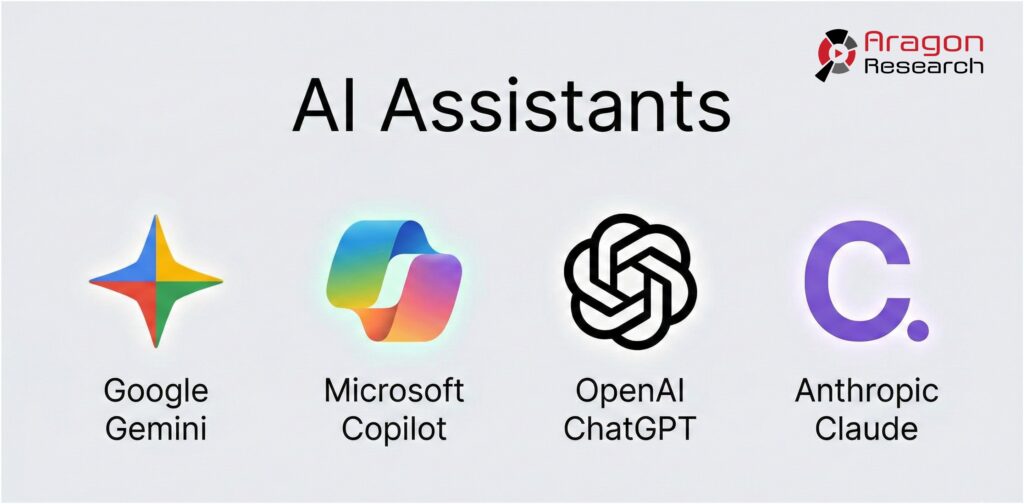
The pressure stems from a perceived gap between the 150 million weekly active users across all Copilot versions and the massive 800 million weekly active users currently engaging with OpenAI ChatGPT and 650 Weekly Average Users for Google Gemini.
The narrative from Redmond focuses on the transition from “experimentation” to “habitual use” within the enterprise. While the consumer numbers for Copilot lag behind OpenAI and Google, Microsoft is betting on the high-value “seat” rather than the casual “chat.”
Analysis
The disparity in weekly active users (WAU) reveals a significant fragmentation in how the market consumes AI. ChatGPT remains the primary “front door” for the general public, maintaining a massive 800 million WAU. Google has successfully leveraged its browser and mobile dominance to propel Gemini to 650 million users. In contrast, Microsoft’s 150 million WAU suggests that while Copilot is ubiquitous in the interface, it has not yet become the default starting point for the average web user.
| Vendor | Weekly Active Users (Estimated) | Focus Area |
| OpenAI (ChatGPT) | 800 Million | Consumer / Prosumer |
| Google (Gemini) | 650 Million | Ecosystem / Workspace |
| Microsoft (Copilot) all forms of Copilot | 150 Million | Enterprise Productivity |
| Anthropic (Claude) | 20 Million | Developer / Specialized |
Table 1: Estimated Weekly Active Users (Sources: Vendors and Wall Street Journal).
Aragon Research views this not as a failure of Microsoft, but as a shift in market segmentation. Google’s strategy of baking “secure” Gemini versions into nearly Business Workspace SKUs (Google claims 9 million business customers) demonstrates that ease of acquisition is more important to buyers than the separate effort to procure a premium ‘seat’ that does not come with premium value.
However, the real battle is in the “stickiness” of the assistant. Anthropic, with an estimated 20 million users, is proving that a smaller, specialized user base can thrive by targeting high-complexity tasks like coding and long-form legal analysis. The market is moving away from a winner-take-all scenario toward a functional hierarchy where users choose assistants based on the specific “job to be done.”
Enterprise Recommendations
Enterprises should not be distracted by the fluctuations in vendor stock prices or the sheer scale of consumer usage. Instead, evaluate these offerings based on their integration into your existing technology stack and the specific data privacy tiers they offer. Google Gemini’s inclusion in Workspace SKUs provides an immediate path to broad internal adoption, but it requires a careful audit of which “secure” versions are active.
For organizations invested in the Microsoft ecosystem, the 160% growth in paid Copilot seats suggests that the tool is finally moving past the “novelty” stage. Decision-makers should prioritize evaluating the “agentic” capabilities of these assistants—their ability to actually execute tasks within apps—rather than just their ability to summarize text. Consider a multi-assistant strategy where different departments utilize the tool best suited for their specific workflows.
Bottom Line
The AI assistant market is currently a tale of two metrics: massive consumer reach versus deep enterprise penetration. While ChatGPT and Google dominate the volume of conversations, Microsoft and Anthropic are carving out high-value niches in the professional and developer sectors. Enterprises must look beyond the “hype” of user counts and focus on the measurable productivity gains and security protocols offered by their specific vendor choices.
Have a Comment on this?