


CrowdStrike Secures AI Agents at RSAC 2026
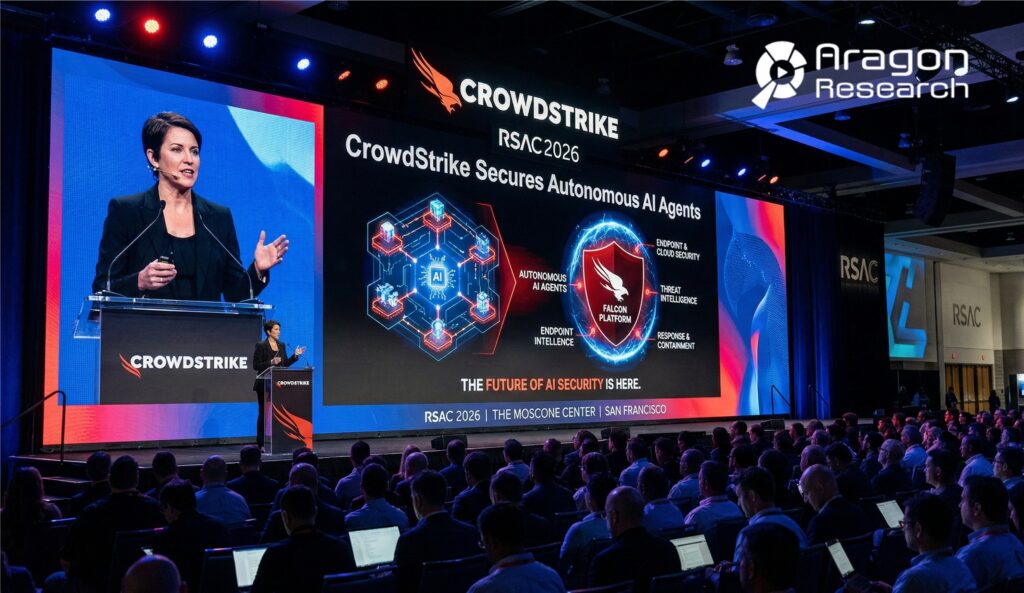
Image design by Aragon Research, rendered by Gemini
By Jim Lundy
CrowdStrike Secures AI Agents at RSAC 2026
The rapid proliferation of autonomous AI agents within the enterprise has created a new frontier for security vulnerabilities that traditional perimeter defenses are unprepared to manage. As these agents gain the ability to execute system-level commands and access sensitive data silos, the endpoint has re-emerged as the primary battleground for visibility and control. This blog overviews the CrowdStrike AI Security Innovations news and offers our analysis.
RSAC was really the culmination of the realization that Agentic AI is here to stay and now security firms must do something about it. In our RSAC Summary Blog, we discussed all of the news at the event. This blog dives deeper into what CrowdStrike is doing and let’s just say that it is good to see market leaders like CrowdStrike, Cisco, Google, Okta and others jumping onto this category that Aragon identified in June 2005.
Analysis of the CrowStrike news at RSAC
This announcement signals a fundamental pivot in the Endpoint Detection and Response (EDR) market from securing human-initiated actions to governing autonomous machine behaviors. While many competitors focus on securing the LLM model itself, CrowdStrike is betting that the primary risk resides at the point of execution. The strategy suggests that the endpoint and the browser are the new battlegrounds for AI governance.
The integration of Seraphic technology is a critical component of this strategy, allowing for the monitoring of agentic activity within the browser where most SaaS-based AI interactions occur. We believe this move positions CrowdStrike as a mandatory gatekeeper for the emerging agentic enterprise. It forces a market shift where traditional malware detection becomes secondary to AI policy enforcement and runtime behavioral analysis.
Competitors will likely be forced to accelerate their own browser-level security and runtime monitoring or risk losing relevance as AI agents become the primary users of corporate systems. The emphasis on shadow AI discovery is a pragmatic admission that most enterprises currently lack a comprehensive map of their AI data flows. By identifying these hidden runtimes, CrowdStrike is moving up the stack to provide business-level risk management rather than just technical threat detection.
What Should Enterprises Do?
Enterprises should evaluate these new capabilities as a way to formalize their AI adoption strategies without stifling innovation. It is critical to move beyond viewing AI security as a simple data loss prevention problem and start viewing it as a system-wide governance requirement. Organizations should audit their current EDR and browser security stack to determine if they can see—and stop—unauthorized agentic workflows.
As autonomous agents begin to handle more financial and operational tasks, the risk of “agent hijacking” or prompt injection becomes a board-level concern. Leaders should consider how these tools integrate with existing identity and access management frameworks to ensure agents do not exceed their intended scope. Testing these runtime protection features in a controlled environment will help teams understand the performance impact of monitoring high-frequency AI transactions.
We recommend that IT leaders review their current endpoint protection capabilities to determine if they can distinguish between legitimate user activity and unauthorized autonomous agent actions. This news should serve as a prompt to update internal AI usage policies to include specific guidelines for agentic systems and automated workflows. Besides the tactical actions, enterprises need to evaluate all of their current approaches to Identity and Security to add Agentic Identity and Security to their overall approach. Without this – the enterprise will remain vulnerable to increasingly sophisticated Agentic attacks.
Bottom Line
CrowdStrike is correctly identifying that the next era of security is defined by the governance of autonomous agents rather than the protection of human users. Enterprises must shift their focus toward securing AI at the point of execution to prevent ungoverned agents from creating massive security loopholes. Adopting a runtime-centric security model is a necessary step for any organization looking to safely deploy agentic workflows at scale.
Have a Comment on this?