

Dialpad & Google: Deep AI Integration
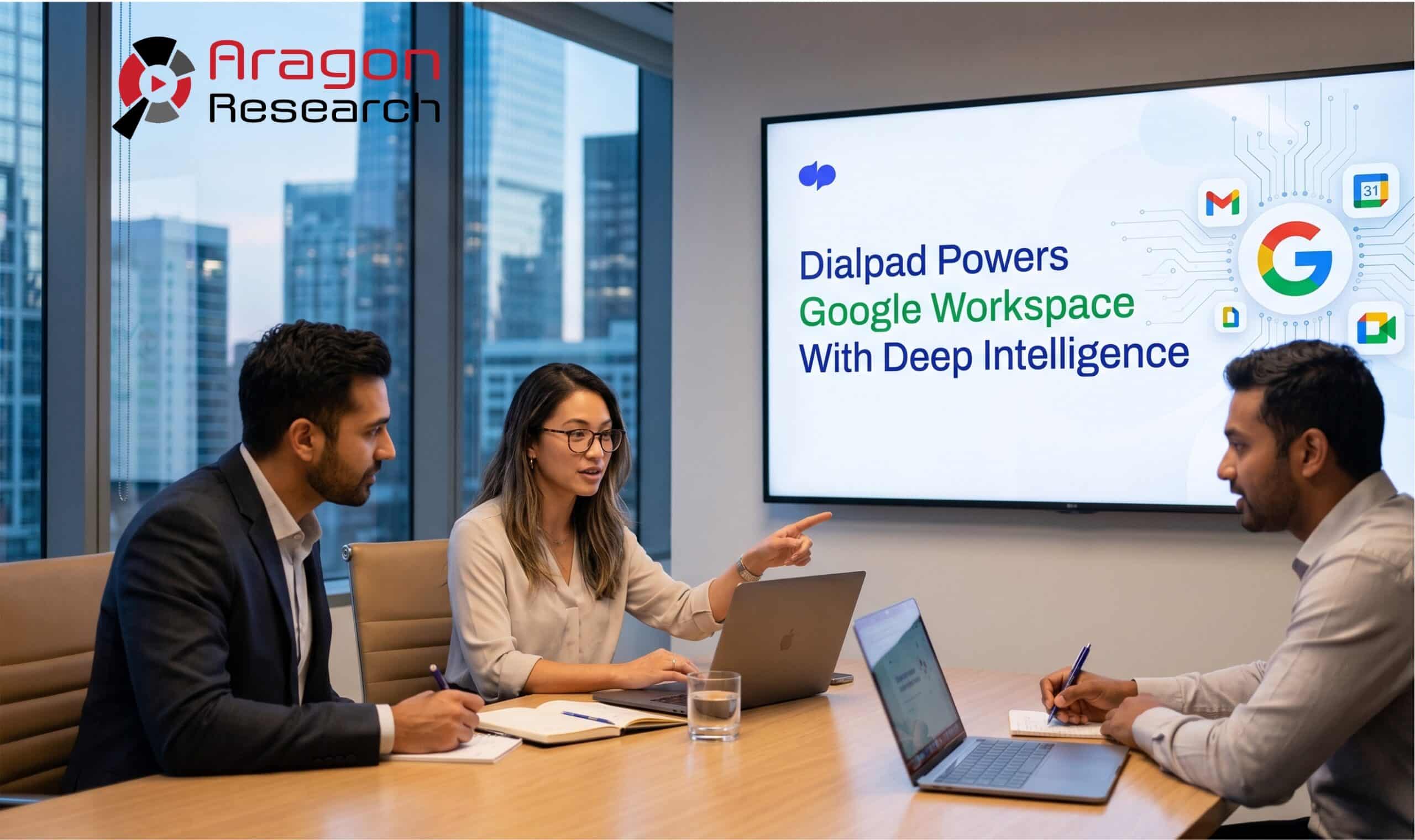
Image design by Aragon, rendered by Gemini.
By Jim Lundy
Dialpad & Google: Deep AI Integration
The business communications sector continues to evolve as unified communications platforms seek deeper integration into the daily workflows of enterprise users. A seamless flow of communication data into productivity suites remains a primary objective for organizations looking to optimize worker efficiency. This blog overviews the Dialpad integration with Google Workspace and Gemini Enterprise and offers our analysis.
Why Did Dialpad Announce Google Gemini Enterprise Integration
Dialpad introduced this deep integration to bridge the gap between real-time communication streams and foundational enterprise repository environments. Corporate intelligence often becomes siloed within individual communication logs or call transcripts, preventing broader application. By embedding these assets natively into the productivity suite, information becomes readily accessible within standard workflows.
The move expands on the vendor platform architecture to provide contextual value directly where teams execute tasks. Users gain the capability to query live conversation data using natural language prompts within their daily email and document software. This shift targets the operational latency that typically occurs when shifting between disjointed platforms.
Analysis
Google has been not been pushing Google Voice and since Dialpad runs in the Google Cloud, this integration makes sense. Traditional communications vendors can no longer rely on standalone portals or basic customer relationship management logging to satisfy enterprise demands. Integrating conversation data into a broader artificial intelligence context changes the value proposition from simple connectivity to active knowledge management.
For the enterprise communications market, this step increases the competitive pressure on rival platform providers to establish similar deep platform ties. Vendors without native, low-latency access to the primary productivity ecosystems will face growing adoption friction in large operations. This development implies that communication tools will increasingly be evaluated on their repository integration capabilities rather than their isolated feature sets.
Technical Mechanics: Loading and Evaluating Conversation Histories
To truly understand the value of this integration, it helps to look at how Dialpad and Gemini operate under the hood to ingest, maintain, and evaluate conversation histories. Rather than relying on static, manual synchronization or rigid CRM logging, Dialpad transcripts and real-time conversation intelligence are natively ingested into the Gemini Enterprise architecture.
1. Ingestion and Context-Preserving Hydration
When a customer call, meeting, or message string occurs on Dialpad, Dialpad AI generates a live, timestamped transcript alongside localized “Moments” (such as action items or sentiments). Instead of locking this data inside a standalone portal, the integration utilizes server-side state management to continuously “hydrate” Gemini’s context window.
When a user opens Gemini in Gmail, Docs, or Chat and references a specific account, the integration dynamically loads the corresponding historical interaction log without requiring the user to copy-paste data or bounce between tabs.
2. Cross-Channel Synthesis and Evaluation
Once loaded, Gemini doesn’t just display the history—it actively evaluates it. It synthesizes Dialpad’s raw conversation logs alongside existing Workspace parameters (like email threads, calendar invites, and shared Google Docs).
What Should Enterprises Do About This News
Organizations utilizing Google environments should evaluate Dialpad to determine the potential benefits of deployment. IT leaders must assess how introducing real-time communication data into the corporate knowledge base alters current data access workflows.
Testing the capability within specific sales or support groups will help identify quantifiable productivity changes. It is important to review the governance and security frameworks associated with sharing conversation data across these systems before planning a wider deployment.
Bottom Line
The integration of real-time communication data into standard productivity suites marks an essential step toward eliminating information silos. Enterprises must recognize that communication platforms are transitioning into core components of the corporate knowledge stack. Organizations should carefully analyze how these integrated intelligence workflows can enhance operational visibility and decision speeds while maintaining strict data governance controls.
Have a Comment on this?