


Gemini 3.5: Rewriting the AI Cost-to-Perf Ratio
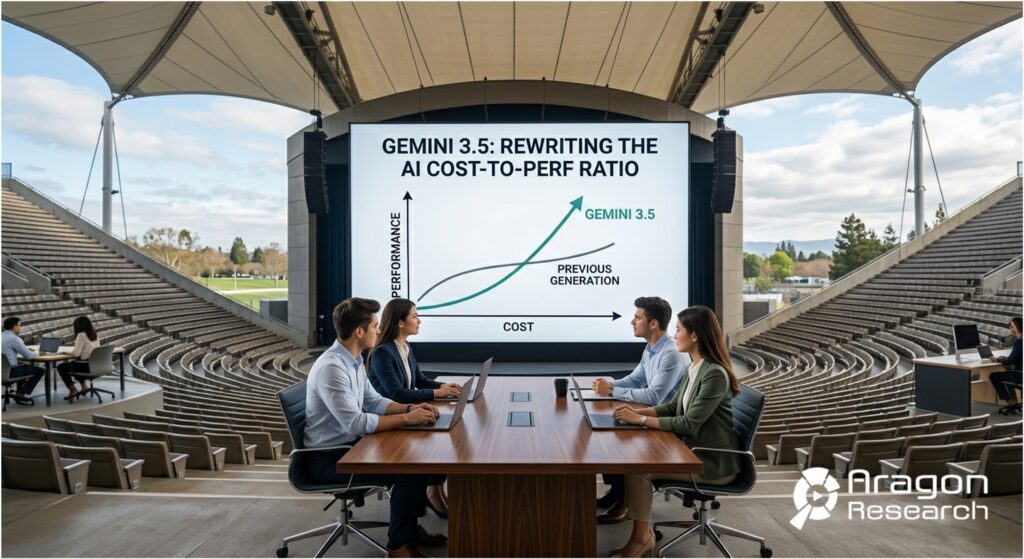
Image design by Aragon, rendered by Gemini.
By Jim Lundy
Gemini 3.5: Rewriting the AI Cost-to-Perf Ratio
This week the long term investments in AI hardware and software paid off for Google. Google announced Gemini 3.5 Flash at its annual Google I/O developer conference to target high-velocity enterprise workloads. This blog overviews the Gemini 3.5 Flash news and offers our analysis.
Why Did Google Announce Gemini 3.5 Flash
Google introduced this model to address the growing demand for cost-effective speed combined with advanced reasoning capabilities. Previous iterations of smaller models required enterprises to sacrifice deep intelligence in order to achieve low latency. The vendor designed this update to handle complex, long-running agentic tasks without the massive computational costs typically associated with frontier models.
This announcement targets the operational bottleneck where organizations want to deploy autonomous agents but find large flagship models too expensive for continuous operation. By focusing on multi-agent sessions, Google aims to capture high-volume developer pipelines and repetitive enterprise workflows.
The strategy behind this launch aligns with the vendor’s push into broader cloud-based background processing ecosystems. By providing an affordable engine that maintains high performance over extended reasoning cycles, Google hopes to lock developers into its orchestration frameworks. It addresses the immediate industry problem where the cost of iterative testing slows down enterprise production deployment.
Analysis
The release of Gemini 3.5 Flash changes the dynamics of the infrastructure layer in the artificial intelligence market. It indicates that the race for massive parameter size is temporarily taking a backseat to the race for operational efficiency and agentic orchestration. Google is shifting the battleground from theoretical benchmark scores to practical execution economics.
This move means that competing vendors will need to replicate this balance of speed and reasoning or risk losing the mid-tier enterprise market. It forces a realization that full automation requires continuous background processing, which is only sustainable if token costs drop significantly. Organizations can now consider deploying persistent digital workers that execute multi-step research and coding projects autonomously.
Furthermore, this development bridges the gap between simple chat interfaces and complex enterprise automation. When a smaller model can outperform older, larger versions on specific coding and reasoning benchmarks, the economic justification for massive models weakens. The market will likely see a polarization where enterprises use specialized, hyper-fast models for daily workflows and reserve flagship intelligence for rare, highly complex edge cases.
How Google played the Long Game in AI Infrastructure
This aggressive pricing and efficiency breakthrough is the direct result of a long-term hardware bet that began back in 2013. When Google engineers realized that scaling voice search would require doubling their entire global data center footprint, they quietly began designing custom silicon. Over a decade of iterating on these Tensor Processing Units has created a massive vertical integration advantage. While competitors remain heavily reliant on third-party graphics processors, Google leverages its proprietary silicon architecture to run workloads at a fraction of the cost, passing those savings directly to enterprise buyers through models like Flash.
Enterprise Implications
Enterprises need to evaluate this offering against their current portfolio of large language models. The capability to run autonomous, iterative sessions changes how application development teams should design internal software workflows. IT leaders must understand how this model fits into their existing technology stack, particularly regarding data privacy and grounding tools.
Rather than treating this as a simple software update, technology buyers should consider its implications on cost optimization. High-latency flagship models can now be reserved for edge cases, while high-velocity tasks move to efficient engines. Organizations should map out their agentic roadmap to see where autonomous workflows can replace standard chat interfaces.
Application development managers should specifically test this model on repetitive code maintenance and data synthesis pipelines. The reduced operational friction means that projects previously deemed too expensive for automation are now financially viable. Reviewing the API pricing structure against current consumption patterns will reveal immediate opportunities for infrastructure cost reduction.
Bottom Line
Google is steering the industry toward practical utility by prioritizing agentic capabilities at a lower price point. Gemini 3.5 Flash represents a broader market trend where execution speed and context retention matter just as much as raw intelligence. Enterprises should actively analyze their current artificial intelligence development costs and determine if shifting to highly optimized models can accelerate their automation timelines.
Have a Comment on this?