


HPE shifts to Zero Trust Network Security
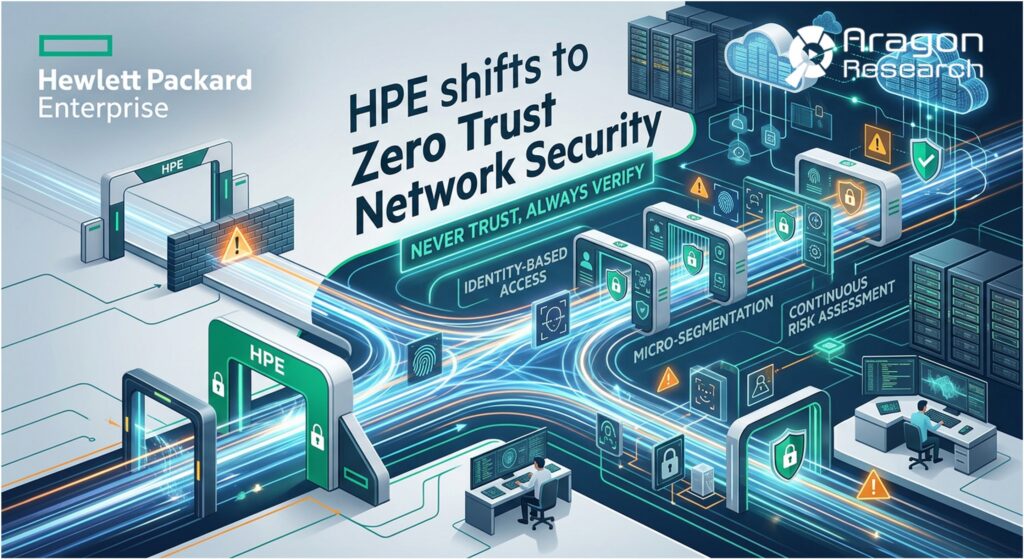
Image design by Aragon, rendered by Gemini.
By Ken Dulaney
HPE shifts to Zero Trust Network Security
The recent suite of announcements from HPE at the RSA Conference 2026 signals a major shift in how enterprise connectivity and cloud infrastructure are protected. As organizations grapple with the increasing complexity of AI-driven threats and stringent global regulations like DORA, the traditional perimeter is no longer sufficient. This blog overviews the HPE Aruba Networking and GreenLake security expansions and offers our analysis.
Why did HPE announce zero trust and sovereign cloud enhancements?
The primary driver behind these updates is the need for a unified security posture that spans from the edge to the private cloud. HPE introduced cloud-based Network Access Control (NAC) within HPE Aruba Networking Central to enforce a strict zero trust policy where no user or device is trusted by default.
Simultaneously, the firm launched “threat-adaptive” security features for HPE Private Cloud Enterprise, including a digital circuit breaker that can physically disconnect infrastructure from the internet during active attacks. These moves are designed to help highly regulated industries, such as finance and government, maintain operational resilience and meet new sovereign data requirements.
What did HPE announce at RSAC 2026?
HPE introduced several security innovations aimed at securing AI adoption and maintaining consistent governance across distributed environments:
- HPE Juniper Networking SRX400 Series Firewalls: Extends carrier-grade, hardware-rooted security to edge and space-constrained environments.
- Expanded Hybrid Mesh Security: Adds new AI governance capabilities without blocking productivity. Features include visibility and access controls for AI sites, prompt-level inspection to prevent data loss, and centralized identity-based protection.
- High-Stakes Threat Protections:
- Workload Resilience: Enhanced cyber and disaster recovery for virtualized and AI workloads in HPE Zerto Software.
- Confidential Computing: Integrated into HPE Morpheus Software to keep data encrypted while in use via hardware-based trusted execution environments.
- Post-Quantum Readiness: PQC-ready capabilities added to Junos OS Evolved to defend against future quantum decryption threats.
- HPE Threat Labs Expansion: Adds deeper networking telemetry to deliver real-time, AI-native threat insights.
The primary driver behind these updates is the need for a unified security posture that spans from the edge to the private cloud. HPE introduced cloud-based Network Access Control (NAC) within HPE Aruba Networking Central to enforce a strict zero trust policy where no user or device is trusted by default.
Analysis
This announcement represents a strategic pivot for HPE, moving from simple network connectivity to providing a “resilience-as-a-service” model. By integrating a digital circuit breaker and air-gapped management into the GreenLake ecosystem, HPE is addressing the specific fears of the C-suite regarding total system compromise. This goes beyond standard encryption; it is an architectural insurance policy that ensures a firm can continue to operate internally even when the external world is under siege.
Furthermore, the focus on post-quantum cryptography in the new ProLiant Gen12 servers and the automation of zero trust policies suggests that HPE is preparing for a future where manual security intervention is too slow. The integration between HPE Aruba Networking and OpsRamp for third-party observability is particularly telling. It shows that HPE recognizes the reality of heterogeneous environments, allowing IT leaders to manage security across Cisco or Juniper hardware within the HPE framework. This move positions HPE as the primary governance layer for the entire hybrid cloud stack, effectively commoditizing the underlying networking hardware of its competitors.
Zero Trust and Slowing Down Bad AI Agents
The implementation of Zero Trust is a critical component of a much larger initiative that Aragon refers to as Agentic Identity and Security Platforms (AISP). As malicious AI agents become faster and more sophisticated, AISP provides a comprehensive framework to counter them. Zero Trust directly supports these AISP efforts by actively removing weak access vulnerabilities, ensuring that unauthorized and potentially destructive agents are slowed down and prevented from easily exploiting the network.
Next Steps for Enterprises
These moves by HPE are designed to help highly regulated industries, such as finance and government, maintain operational resilience and meet new sovereign data requirements. Enterprises should evaluate these new zero trust and sovereign cloud capabilities as a blueprint for modernizing their defense-in-depth strategies. It is important to determine if your current infrastructure can support the granular, role-based access controls now available via the cloud-based NAC.
For firms operating in the EU or those with high-security mandates, the threat-adaptive security and air-gapped management options should be considered as a primary means of achieving DORA compliance. Organizations should audit their existing hardware to see if a transition to post-quantum ready servers is necessary to future-proof their data against emerging decryption threats.
Bottom Line
HPE is setting a new standard for how infrastructure must defend itself in an era of automated, AI-enabled cyberattacks. The combination of automated zero trust networking and sovereign cloud isolation offers a level of resilience that was previously only available to the most sophisticated intelligence agencies.
Enterprises should move quickly to understand how these “secure by design” principles can be integrated into their technology stack to mitigate risk. Adopting these multi-layered defenses today will provide the necessary foundation for safely deploying AI and hybrid cloud applications tomorrow.
Have a Comment on this?