

Workspace Intelligence: Google’s New Agentic Play
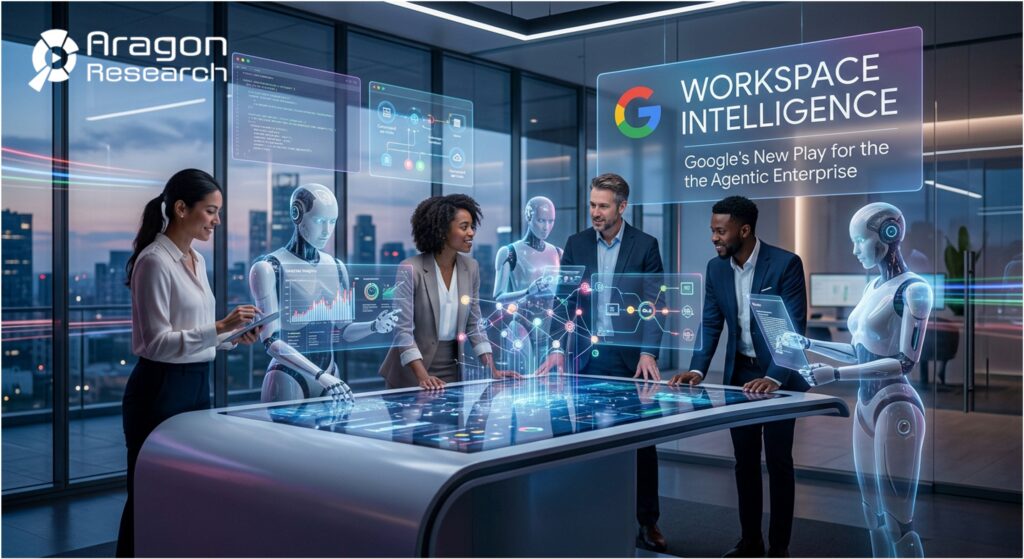
Image design by Aragon, rendered by Gemini.
By Jim Lundy
Workspace Intelligence: Google’s New Agentic Play
Most professionals spend their days in a state of digital whiplash, toggling between tabs, hunting for a critical chart buried in an email, or digging through chat threads for a long-forgotten decision. This constant digital scavenger hunt means we spend more time stitching together scattered information than performing actual, value-added work. The friction is immense. What if your tools understood your ultimate goal, rather than just acting as a passive canvas for your efforts? With its latest announcement, Google is betting it has the answer. This blog overviews Google’s new Workspace Intelligence and offers our analysis of its market impact.
Why Did Google Announce Workspace Intelligence?
Google’s announcement is a direct response to the universal problem of digital fragmentation and information overload. The vendor’s goal is to create an intelligent, dynamic system that does more than just connect to apps; it seeks to understand the complex semantic relationships between a user’s content, active projects, and key collaborators. The platform is designed to automate the heavy lifting of information gathering, provide situational awareness of what’s important, and deliver true personalization by learning an individual’s unique work style.
A prime example of this new philosophy is “Ask Gemini in Chat,” which functions as a unified command line for all of a user’s work. Instead of issuing a series of small commands, a user can simply state a high-level goal. Gemini then works behind the scenes, leveraging skills to schedule meetings, generate full slide decks, find files using only a vague description, and even connect to third-party tools like Jira or Salesforce to complete complex, multi-step tasks without the user ever leaving the chat interface. This is a fundamental rethinking of the user’s relationship with their software.
Analysis
The introduction of Workspace Intelligence signals a significant strategic pivot by Google to redefine the role of productivity applications in the modern enterprise. This is not merely an incremental feature update but a foundational shift toward an agentic model of work, where the platform itself becomes an active participant in completing tasks. By turning scattered emails, chats, and files into a cohesive, queryable knowledge graph, Google is positioning Workspace as a central nervous system for enterprise knowledge and workflows. This is a calculated and aggressive move.
This puts direct and immense pressure on competitors, most notably Microsoft. The battleground for enterprise productivity is no longer about individual feature sets within a document or spreadsheet application. Instead, the competition now centers on the intelligence of the underlying platform and its ability to provide contextually aware, autonomous agents. The vendor that can provide the most capable and trustworthy agent will likely win the next decade of enterprise software. Furthermore, Google is wisely addressing enterprise concerns head-on by emphasizing security and governance as a core part of its “AI-first trifecta,” promising that an organization’s data remains its own and offering granular admin controls.
What Should Enterprises Do About This News?
This is a development that technology and business leaders cannot afford to ignore. The concept of an AI agent that understands your work context and can act autonomously on your behalf has profound implications for productivity, efficiency, and even job design. This is not a future-facing trend to watch from the sidelines; it is happening now. Enterprises should immediately begin to identify specific, high-friction use cases within their organizations where an agentic platform could deliver significant value and ROI.
For example, project onboarding, complex sales proposal generation, or the compilation of quarterly business reviews are all multi-app, multi-step processes that are ripe for this kind of automation. Forward-thinking organizations should form small, cross-functional teams to evaluate how this technology could reshape critical workflows. The focus should be on moving employees away from mundane information gathering and towards higher-value strategic decision-making. Piloting this technology with a specific, measurable business process is the most effective way to understand its true potential and prepare for a wider rollout.
Bottom Line
Google Workspace Intelligence is a bold declaration that the future of work is not just AI-assisted, but fundamentally agent-driven. It represents a strategic move away from passive, single-purpose tools toward a proactive, intelligent system designed to understand user intent and automate complex, cross-application tasks. For enterprises, this is a clear signal that the way we work is about to change dramatically. Organizations must recognize this paradigm shift and start planning for a future where intelligent agents are a core component of their productivity and collaboration strategy. The era of endlessly toggling between tabs may finally be coming to an end.
Have a Comment on this?